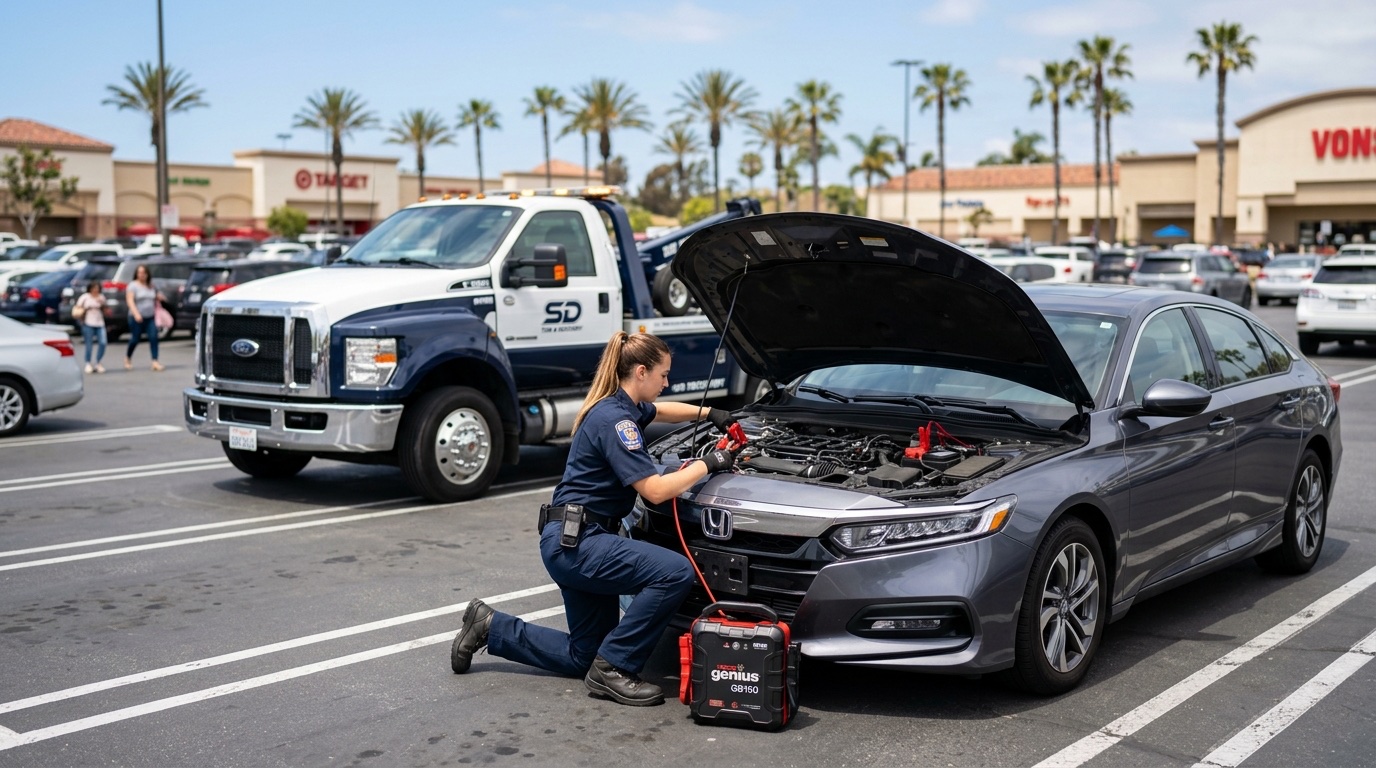
A dead battery on a below-zero morning usually needs a jump, not a tow, but not always. If the engine cranks slowly or the dash lights are weak, a jump-start will probably get you moving. If nothing happens at all, or the car dies again a block later, you likely need a tow to a shop. Start with a jump, because it is faster and cheaper, and move to a tow only when a jump fails.
Why cold kills batteries here
The Twin Cities average around 51 inches of snow a year and rank among the coldest major metros in the country, with record lows past 40 below. Cold thickens the oil the engine has to turn and cuts the chemical output of the battery at the same time, so a battery that was merely weak in October quits in January. A jump-start feeds it enough to start and then the alternator recharges it as you drive.
When a jump is enough
Try a jump first if:
- The engine cranks, even slowly, when you turn the key.
- The lights, radio, or dash come on but dim.
- The battery is a few years old and the car has been sitting in the cold.
After a successful jump, drive for a solid 20 to 30 minutes to let the alternator recover the charge, or the car may not restart. If it starts fine the next few mornings, the battery was just low. If it dies again, the battery or the charging system needs a shop.
When you need a tow instead
Skip the jump and call for a tow when:
- Nothing happens at all, no crank, no lights, and a fresh jump does nothing.
- The car starts on a jump but dies again within a block or two, which points at the alternator, not the battery.
- You smell burning, see corrosion or a swollen battery case, or the car will not go into gear.
In those cases a jump is a waste of a cold half-hour. A flatbed to a nearby shop is the real fix.
Free help that many drivers do not know about
If you are stuck on a metro freeway on a weekday, MnDOT’s FIRST crews may reach you before anyone else. FIRST patrols 11 routes across about 220 miles of Twin Cities freeways, roughly 6 a.m. to 8 p.m. Monday through Friday. They push disabled vehicles out of live lanes, jump-start batteries, change flat tires, hand out a little gas, and call a tow when one is needed. FIRST does not tow the car itself, and for an active emergency you should dial 911.
Getting roadside help
Off the freeway, or after hours, Quick Tow Minneapolis can point you to help. We are a referral service. We take the call and match you with an independent local operator who covers your part of the metro, from downtown Minneapolis to the East Side of St. Paul to the northern suburbs along I-694. Tell us whether you need a jump or a tow, where you are, and what the car is doing, and the operator quotes it before rolling.
Frequently asked questions
Is a jump-start or a tow cheaper? A jump is usually the cheaper and faster fix when the battery is just low. A tow makes sense only when a jump fails or the problem is the charging system, not the battery.
How long should I drive after a jump? Give it 20 to 30 minutes of driving so the alternator can recharge the battery. A short hop may leave it too weak to restart.
Can MnDOT FIRST jump my car? Yes, on the metro freeways they patrol, roughly 6 a.m. to 8 p.m. weekdays. They jump batteries and change tires, but they do not tow. Dial 911 in an emergency.
My car started on a jump but died again. What is wrong? If it dies again quickly, the alternator is probably not charging the battery. That needs a shop, so a tow is the right call rather than another jump.